
7 MIN READ
Can You Make Maple Floors Look Like White Oak?
September 9, 2026
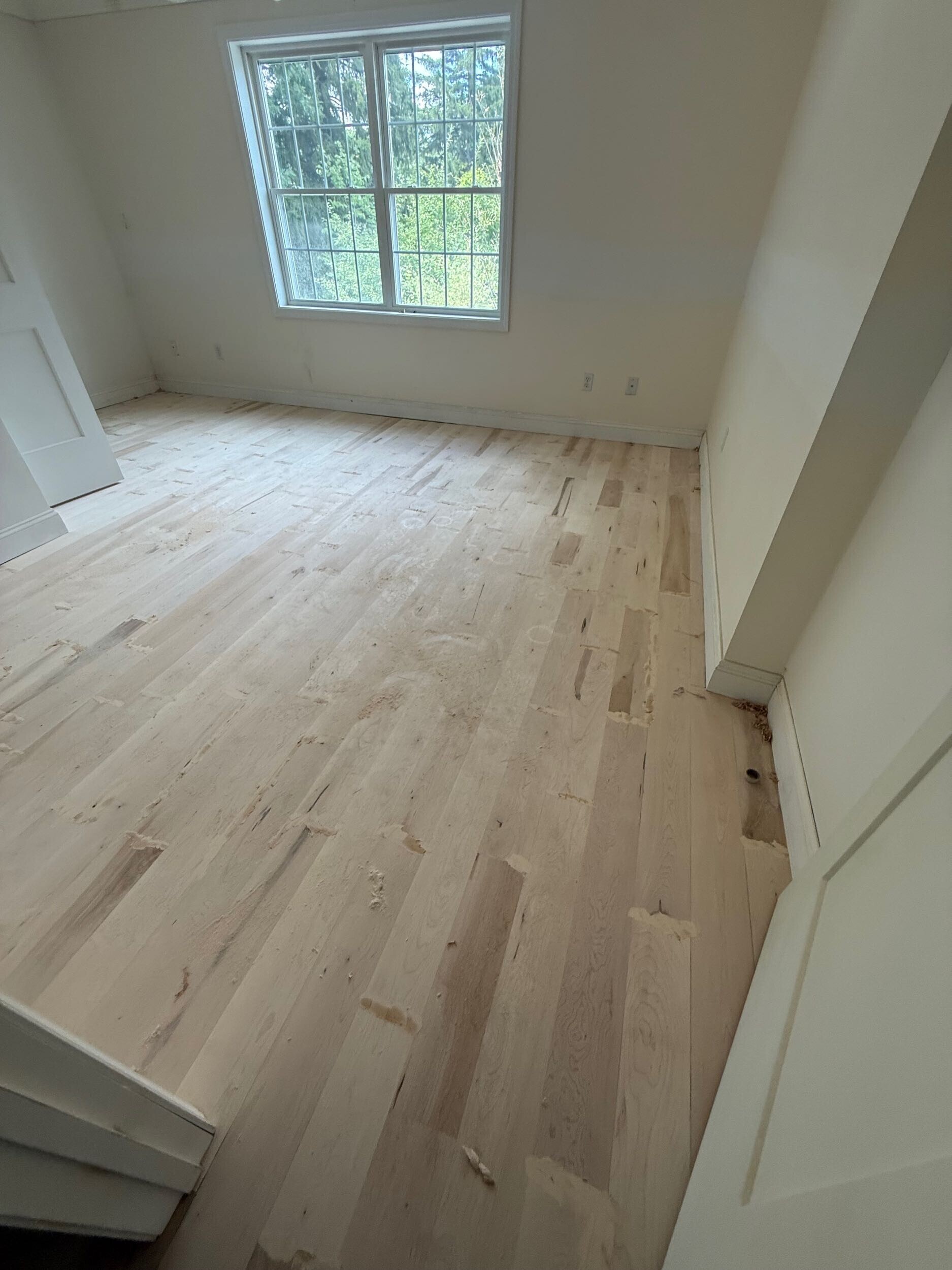
White oak has become the reference point for light, quiet, natural-looking floors. So when an existing maple floor is darker or more varied than expected, homeowners often ask a reasonable question: can the right stain or sealer make it look like white oak?
On a recent Connecticut remodeling project, that question could not be answered honestly with a catalog photo or a sample board. Once the existing prefinished maple was sanded, the floor revealed pronounced color variation from board to board. Some pieces were pale and creamy. Others were noticeably darker. The old gray finish had also penetrated into deep factory-beveled seams.
Instead of promising that one product would erase those conditions, our team worked through the problem with the flooring installer, supplier, manufacturer technical department, and designer. We tested finishes on the actual floor and compared what each option could—and could not—do.
THE SHORT ANSWER
Maple Can Be Lightened, but It Will Not Become White Oak
A finish can change color, sheen, and contrast. It cannot change the wood species, grain pattern, or natural variation already present in the boards.
Whitewash or a pale sealer may move maple toward the same light visual family as white oak, but maple will still read as maple. If the goal is an exact, consistent white-oak appearance, refinishing has a limit that should be understood before work continues.
WHAT THE FLOOR REVEALED
The Surprise Came After Sanding
The original finish had visually blended some of the floor. After sanding, the true range of the maple became much easier to see. The darkest boards were not surface stains that could simply be sanded away; much of the contrast was the natural material itself.
Because the flooring was originally prefinished, each board also had a deep beveled edge. The former gray stain had worked down into those joints. More aggressive sanding could reduce the remaining gray, but removing too much material creates a different risk. A responsible solution had to balance appearance with the long-term condition of the floor.
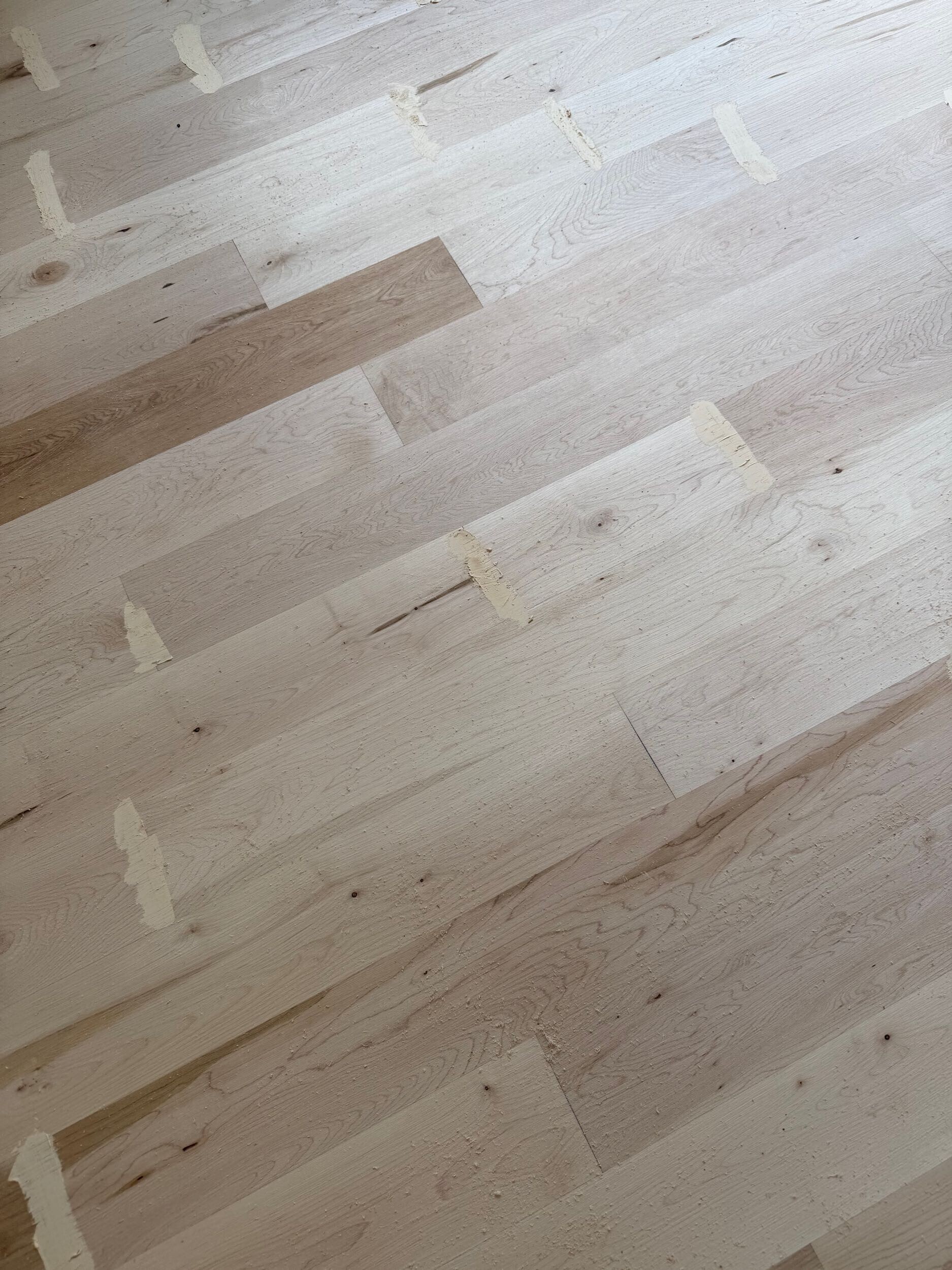
The actual sanded floor showed more useful information than a small showroom sample ever could.
WHY WOOD SPECIES MATTERS
Maple and White Oak Take Finish Differently
White oak has a more open, visible grain and usually accepts color in a way that emphasizes that texture. Maple is tighter-grained and can react less evenly to stain. Light finishes may turn slightly yellow on maple, while whitewash on red oak can lean pink. Those undertones matter when the target is a clean, pale floor.
The important point is simple: stain is not paint. A translucent finish still allows the character and color of each board to show through. That is often beautiful, but it may not match an inspiration photo built around a different species.
The darkest boards set the practical limit. A pale finish can brighten the light boards, but it cannot make naturally dark maple uniformly pale.
THE REAL-WORLD TEST
We Put the Options on the Actual Floor
Sample boards are useful, but they cannot reproduce the exact species mix, age, previous finish, lighting, and board variation in an existing home. For this project, finish samples were placed directly on the sanded floor in the primary bedroom so everyone could judge them in context.
The options included:
- Bona Whitewash with a traffic finish: lightened the overall look and softened some contrast, with a beachier appearance.
- Bona NordicSeal: kept the maple natural and softened the tone, but still allowed substantial board variation to remain.
- Bona IntenseSeal: brought forward more of the deeper colors and made the variation feel richer rather than trying to hide it.
- A semi-opaque wheat-toned product: might reduce contrast, but the supplier and manufacturer were not confident it would conceal enough variation to justify relying on it.
- A much darker stain: could blend the floor by working toward the darkest boards, but it would create a completely different design direction.
The team did not choose a favorite from a product name. We evaluated how each finish behaved on this particular floor.
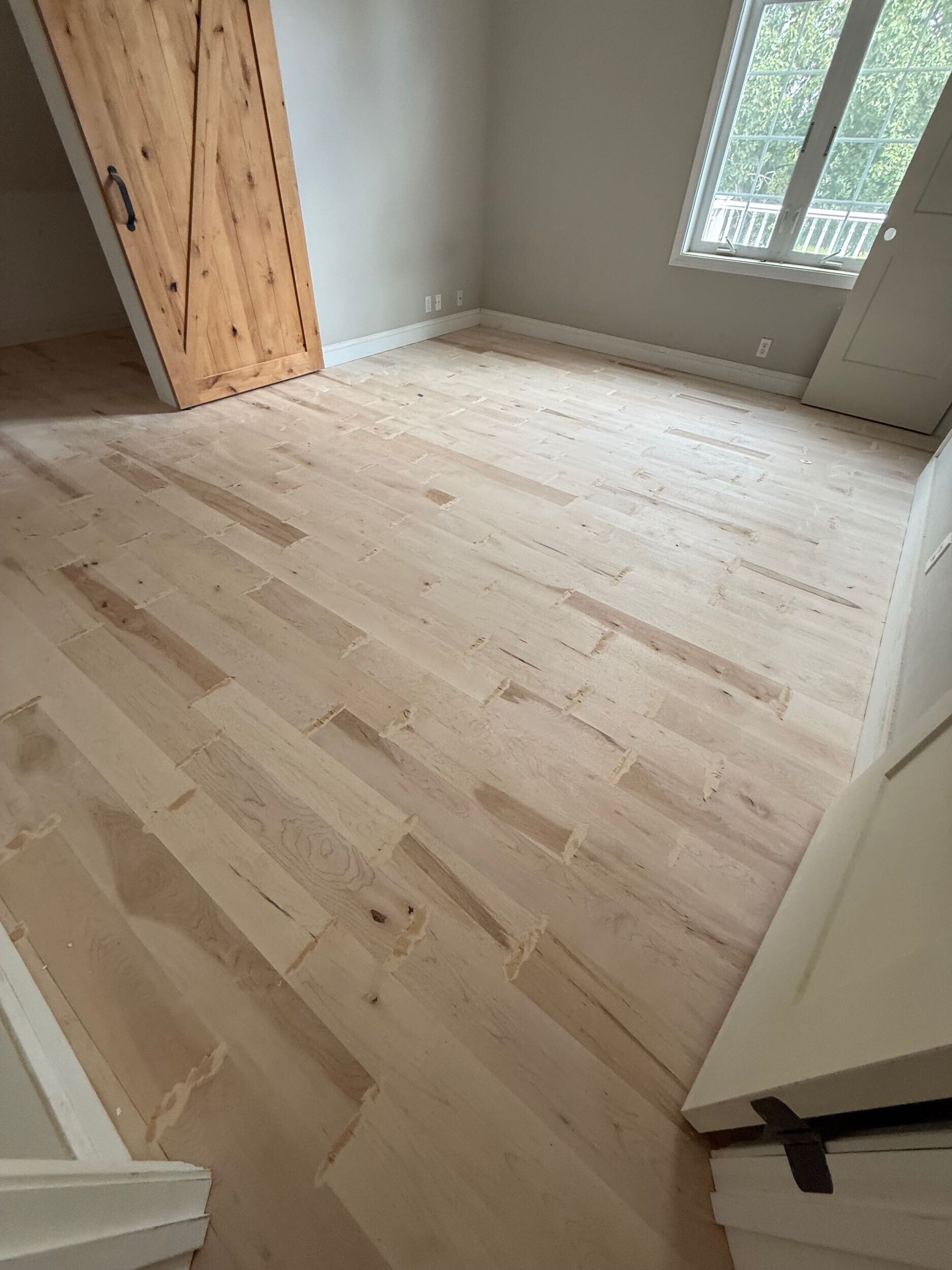
Natural maple variation remained visible across the room, even after the floor was moved toward a lighter finish.
THE TRADEOFFS
What Each Direction Could—and Could Not—Solve
Stay light and accept variation
A whitewash or pale sealer can make the space feel brighter and reduce some visual contrast. It preserves the fact that the floor is real wood, including its naturally darker boards.
Lean into the maple
A natural or richer sealer can stop fighting the species and make its range feel intentional. This is often the strongest choice when the homeowner likes wood character more than uniformity.
Go darker for more blending
A darker color can reduce the gap between the lightest and darkest boards, but it sacrifices the pale look that started the conversation.
WHEN REFINISHING IS NOT ENOUGH
Replacement May Be the Only Reliable White-Oak Result
If the non-negotiable goal is for an upstairs maple floor to look consistently like new white oak, engineered white oak is the more predictable route. It is also the most involved option: demolition, material cost, installation, transitions, schedule impact, and avoidable waste all need to be considered.
Replacement should not be presented as the automatic answer. It belongs on the table only so the homeowner can compare an exact aesthetic goal with the cost and disruption required to achieve it.
THE BETTER QUESTION
Do Not Ask Which Stain Turns Maple Into White Oak
Ask which finish makes this maple floor look its best—and whether that result fits the rest of the home.
That change in wording leads to better decisions. It replaces a promise no product can guarantee with a comparison grounded in the actual room, actual light, and actual wood.
OUR APPROACH
Samples, Specialists, and Clear Expectations
Renovation decisions become difficult when existing conditions do not behave like the design image. Our role is not to force certainty where it does not exist. It is to bring the right specialists together, test the reasonable options, and explain the tradeoffs before the homeowner commits.
In this case, conversations with the installer, flooring supplier, manufacturer technical department, and designer gave the homeowner more than an opinion. The on-floor samples made the decision visible.
PLANNING A REMODEL?
Make Finish Decisions From the Real Materials
If your Connecticut remodeling project includes existing hardwood floors, evaluate the finish on the actual floor before approving the full application. Fine Home Contracting coordinates design, construction, and field testing so decisions are based on what is really in the home.
FREQUENTLY ASKED QUESTIONS
Maple Floor Refinishing FAQ
Can maple floors be stained light?
Yes, but the lightest finishes often reveal rather than erase natural variation. Test the product on several areas of the actual floor.
Why does maple stain unevenly?
Maple has a tight grain and areas of different density, so stain can absorb unevenly and look blotchy or more varied than it would on oak.
Will whitewash hide dark maple boards?
It can soften the contrast, but it will not make the darkest boards match the lightest ones or change the floor into another species.
Should a floor sample be tested in the room?
Yes. Existing wood, previous finishes, daylight, wall colors, and adjacent materials all affect how the result reads.
About the Author: David Perrotti